
Schedule a Consultation

THIS Leader Podcast   

77. Revenue is shrinking. Now what? 

July 28, 2026


Many organizations are contracting right now — funding is thinning, costs are climbing, AI is reshaping jobs at every level, and 55% of employed Americans say they're worried about losing their jobs. Whether or not your organization is considering the need to downsize, that anxiety may already be in the room with you.

In this episode, I get into what these kinds of contraction cycles can do to your people's brains, and how ethical leaders are dealing with it. I share why every one of David Rock's five SCARF threat categories fires during a downturn, why fear shows up looking like disengagement in one person and combativeness in another, and four specific moves for leading through contraction in ways that are more likely to keep your culture — and your people's trust — still intact on the other side.

Listen Now
Photo of Claire Laughlin with the words "with Claire Laughlin"

Listen Now

A colleague told me a story I can't stop thinking about. Someone showed up to work on an ordinary Tuesday, opened Slack, and watched their colleagues' names go gray one by one. They thought it was a glitch. It wasn't. An entire organization was deactivated in real time, no call, no meeting, no warning. In about the time it takes to drink a cup of coffee.

That is NOT how the leaders I know would ever operate. The leaders I work with are thoughtful, transparent, and deeply human; even when they're navigating incredibly difficult decisions.

In this episode, I explore what uncertainty does inside a team, why fear can show up in surprisingly different ways, and how leaders can respond with steadiness instead of urgency. I unpack David Rock's SCARF model, explain why people instinctively fill information gaps with worst-case assumptions, and share practical ways to communicate with greater clarity, care, and consistency.

If you're leading through a season of uncertainty, or preparing for the day one comes, this episode will help you build trust when your team needs it most.
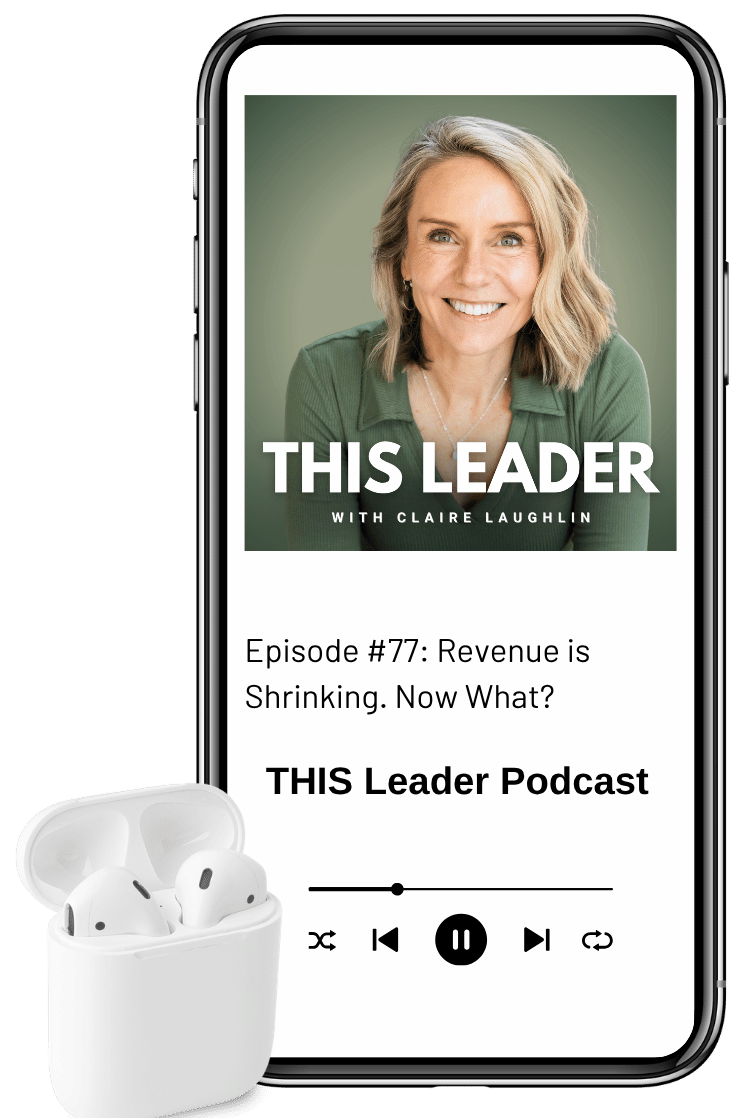

Mock up of podcast episode on phone with air pods Episode #77 "Revenue is Shrinking. Now What?" with Podcast cover art
THIS Leader Podcast
77. Revenue is shrinking. Now what?
19:23
 

"In times of contraction or downsizing, your values are more than inspiration. They're your decision filters."

77: Revenue is shrinking. Now what? 

Imagine opening Slack on an ordinary Tuesday and watching your colleagues' names turn gray, one by one. You refresh. You assume it's a glitch. And then your own access drops, your laptop locks, and your badge stops working.

No call. No meeting. No warning.

That actually happened — and while it is nothing like how the leaders I work with are handling hard times, it might be the story living in the back of your team's mind right now. In this episode, I get into what organizational contraction does to the people you lead, and what you can do to lead the way with coherence, clarity and kindness.


In this episode, you'll hear about:

The moment we're actually in:

Federal and state funding is thinning, costs are rising, AI reshaping work at every layer — and a recent Harris Poll found that 55% of employed Americans are worried about losing their jobs. Their fear is rational, and it may already be happening in your organization.


Why contraction is a different kind of challenge:

Leading in expansion is hard too. But when the tide is rising, even hard conversations happen against a backdrop of momentum. In times of contraction, you're asking people for their best problem-solving while they're quietly wondering whether they're solving their way out of a job.


What's happening in your people's brains:

David Rock's SCARF framework — status, certainty, autonomy, relatedness, fairness — gives us a tangible way of understanding how the brain processes threat.  And, how a frightened brain fills silence with worst-case assumptions rather than waiting for information.


Fear wearing different clothes:

Some people pull back and go quiet. Some get combative and question every decision. Some speed up, working twelve-hour days to prove their value. Three very different behaviors, one underlying cause — and how misreading it as a character problem makes everything worse.


Why contraction is rocket fuel for rumors:

When official information is scarce, people fill the gap with unofficial information — and it gets worse with every retelling.


Four moves for leading through times of contraction

  1. Anchor to your values — (and do this work before you need it!) Your values aren't wall art; they're your decision filters. They determine what you protect and how you make hard decisions. And if you're not in contraction right now, fantastic! You’ve got a runway — use it.


  1. Establish your decision filters. Applying your values helps you make better decisions. One organization I work with runs every restructuring decision through one primary question: how does this impact our members? It doesn't make hard calls easy. It makes them coherent — and coherence keeps trust alive when people are scared.


  1. Slow down, get thorough, and communicate with extraordinary care. Your instinct in times of crisis may be to speed up. But leaders rushing decisions in times of contraction make worse decisions and break more trust — partly because leaders are having their own fear response, and none of us make our best decisions under stress. Bring in your trusted advisors who will actually tell you the truth, then build a deliberate communication cascade so the message that reaches the front line is the one you meant to send.


  1. Be patient with people's fear responses. Patience isn't permissiveness — you still need the work done. It means not reading fear as laziness, or resistance as insubordination. It means factoring human biology into your leadership strategy.


This week's challenge

Begin to name your decision filters. These filters are the criteria that you will use to make your best decisions. Write down the two or three questions every hard decision in your organization has to pass through. Having these filters clarified up front will make every hard decision easier.

If you can't name them, or if your team members all have different ideas about which filters matter most, that's your work.


Resources Mentioned:

  • David Rock's SCARF model — status, certainty, autonomy, relatedness, fairness
  • Harris Poll for Bloomberg News, October 2025 — 55% of employed Americans concerned about losing their jobs
  • Episode with Lisa Alessi on fear based responses —#66
  • Episodes with Dr. Lisa Riegel on brain-based leadership — #58 and #72


Ready to go deeper? If you want to build the kind of leadership foundation that holds in any season — clear values, real decision filters, and enough trust to get you through the hard parts — reach out for a free consultation. Visit ClaireLaughlin.com and click "Schedule a consultationat the top of the page.

Until next time, lead the way!


Subscribe & share: If this episode resonated, share it with a leader who needs to hear it. It helps more than you know!

To learn more about my services, subscribe to my newsletter, and for additional tools to enhance your leadership impact, visit ClaireLaughlin.com and connect with me on social channels @Claire Laughlin Consulting.

Thanks so much for listening to our podcast! New episodes are released weekly, so be sure to subscribe.


LISTEN ON SPOTIFY
REVIEW ON APPLE

Episode transcript

Click here to view the full episode transcript.

Transcript

Subscribe for weekly inspiration

Get it delivered right to your inbox!

Enter your name and email below and you'll get the inside scoop when we release a new episode on the podcast plus weekly leadership inspiration. We know you're not one to miss out on a good thing!

ClaireLaughlin.com needs the contact information you provide to us to contact you about our products and services. You may unsubscribe from these communications at anytime. See our privacy policy for terms and conditions and to learn how we protect your data.

About your Host

Claire Laughlin, MA, Organizational Development Consultant

Hi! I'm Claire Laughlin, and I love helping leaders like you create workplaces where people truly thrive.

For over two decades, I've been rolling up my sleeves alongside teams and organizations, using hands-on methods that actually work (because let's face it - theory only gets you so far!). 

I specialize in teaching leaders how to engage their teams, helping managers become more effective facilitators, and showing people how to work better together.

I'm also a master facilitator for the Six Types of Working Genius® - a fantastic tool that helps you understand and leverage your natural talents.

When I'm not helping leaders like you build happy, high-energy workplaces, I'm enjoying a hike in the forest with my dog Fiona, spending time with my family or curled up with a great book.

Photo of Claire Laughlin looking at her dog

Listen Now

Let's keep the party going!

We have tons of great episodes waiting for you! Check them out on Apple Podcasts and Spotify.
Podcast cover art with words "Episode 76: The Illusion of Alignment"

76. The Illusion of Alignment

Have you ever left a meeting thinking, Great—we're all aligned, only to realize a week later that everyone walked away with something different?

In this episode, I explore the difference between clarity, compliance, and true alignment, and I share a practical four-step process that helps teams move beyond polite agreement to genuine commitment. Because when people are truly aligned, decisions don't keep getting reopened,  and teams are better prepared to move forward together. 
More on this episode
Podcast cover art with the words "Episode 75: Learn Like A Leader"

75. Learn Like A Leader

You are learning all the time! You listen to podcasts, read books and articles, take courses, attend conferences…. But how much of what you learn is really sticking? How much is translating into actionable insights that change the way you learn and lead? 

In this episode, I share two personal experiences that transformed how I approach learning and talk about how the same principles can help you accelerate your leadership growth and feel a real sense of progress.

More on this episode